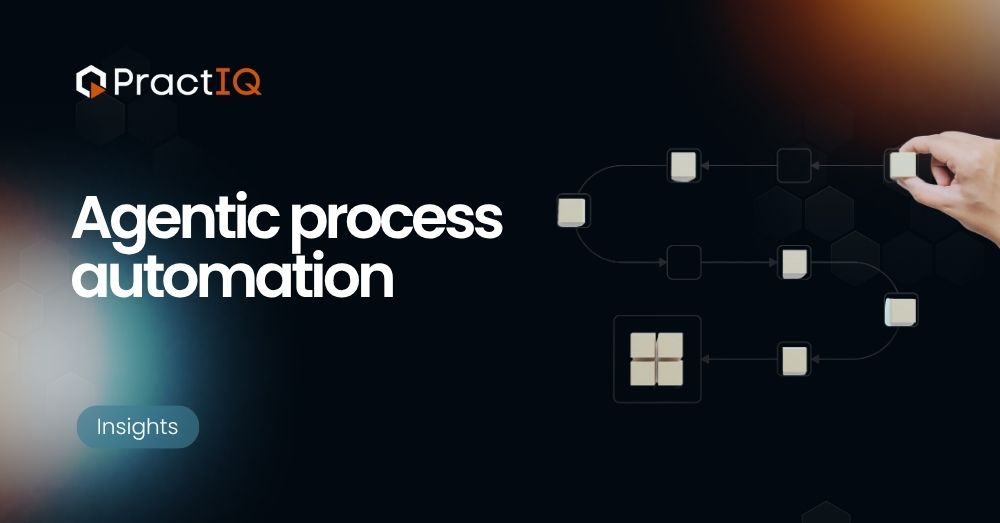
What is agentic process automation?
Agentic process automation is an approach to enterprise automation where AI agents help plan, interpret, execute, and adapt business workflows under clear governance. Unlike static automation, it can handle context, make bounded decisions, and move work forward when a process changes or an exception appears.
In practice, agentic process automation connects documents, systems, approvals, and actions into a more continuous workflow. That reduces manual handoffs, shortens cycle time, and helps enterprises automate work that used to be too dynamic for rule-based tools alone.
How is agentic process automation different from traditional automation?
Traditional automation follows predefined triggers and rules. Agentic process automation goes further because AI agents can interpret context, choose the next best step, and adapt to changing inputs inside a process in real-time.
The difference matters most in enterprise workflows where exceptions, approvals, and cross-system dependencies are common. Traditional automation is strongest in stable, repetitive tasks. Agentic process automation is stronger when the process needs context-aware execution, structured judgment, and human oversight.
| Dimension | Traditional automation | Agentic process automation |
|---|---|---|
| Scope | Narrow, repeatable tasks | End-to-end workflow support |
| Decision making | Rule-based | Context-aware with guardrails |
| Human role | Configures and monitors | Directs, reviews, and governs |
| Adaptability | Low | Higher in changing workflows |
| Value | Efficiency in isolated steps | Faster, more resilient process execution |
Where do AI agents fit in enterprise workflows?
AI agents fit into workflows where work must be interpreted before it can be executed. They can support intake, classification, routing, approval preparation, exception handling, document generation, case summarization, and post-action follow-up. The best results come when each step has a clear input, a defined output, and a validation path.
This matters because enterprise process automation is not only about moving data from one system to another. It is about moving work through decisions, checks, and approvals. AI agents reduce friction in that chain by preparing drafts, checking consistency, surfacing risks, and accelerating steps that normally slow teams down.
How do AI agents improve process speed?
AI agents improve speed by reducing the time spent on repetitive but necessary process work, utilizing the capabilities of intelligent automation. They can summarize requests, extract key facts, suggest next steps, and prepare responses faster than manual-only workflows.
The main benefit is reduced latency between intake and action. When agents are integrated into enterprise workflows, teams can move from request to validated outcome faster. That improves throughput, lowers queue time, and shortens feedback loops across business operations.
Which enterprise processes benefit most from agentic process automation?
The highest-value processes are those with frequent handoffs, structured documents, and exceptions that require contextual judgment. Customer service, finance operations, procurement, HR operations, compliance workflows, and internal service requests all benefit, but for different reasons.
Customer service benefits from faster triage and better case routing. Finance benefits from document validation and approval support through automation tools. HR benefits from faster intake and policy-aligned responses. Compliance and operations benefit from traceability, consistency, and earlier risk detection enabled by intelligent automation.
What does an agentic process automation workflow look like?
An effective workflow starts with a clear business goal, then moves through structured decomposition, agent-assisted execution, human review, and validation. The agents should not operate as free-form chat participants but should follow structured workflows defined by robotic process automation. They should work as specialized roles with defined responsibilities inside the workflow.
Typical flow includes request intake, context extraction, task classification, action selection, execution support, exception handling, and completion verification. Each step produces an artifact or state change that can be reviewed or passed to the next stage. That artifact-based design is what makes agentic process automation enterprise-ready and suitable for deployment on an automation platform.
Inside an Agentic Workflow
Tap each stage to see what AI agents do and where humans stay in control
Build governed agentic workflows for your enterprise
Explore PractIQ→What should be governed in agentic process automation?
Governance should cover permissions, traceability, validation, prompt behavior, model usage, and approval boundaries. Without those controls, AI agents can create output that looks productive but is not reliable enough for enterprise workflows.
Process automation needs guardrails because one action can affect downstream systems, compliance obligations, and customer outcomes. Agentic process automation works only when every agent action is visible, reviewable, and aligned with business rules and operational standards. Governance is not a later add-on; it is part of the automation architecture.
How should enterprises measure agentic process automation?
Enterprises should measure cycle time, throughput, quality, review effort, exception rate, and rework rate. These metrics show whether AI agents are helping the organization execute better processes or just generating more activity.
It is also useful to track cycle time by workflow stage, percentage of agent-generated outputs accepted with minimal edits, and time saved in manual handling. Those metrics connect the automation layer to operational outcomes and help leaders understand where the model creates the most value.
How does agentic process automation change architecture and operations work?
It changes architecture and operations by making context preparation faster and more consistent. AI agents can summarize systems, compare dependencies, draft workflow alternatives, and prepare analysis for human owners. This reduces the time spent assembling information and increases the time spent making decisions.
The best use case is not autonomous operations. The best use case is operations support with strong review. That means AI agents help gather facts and structure options, while humans retain responsibility for trade-offs, exceptions, and system-level choices.
How do AI agents support process design and workflow execution?
AI agents support process design by identifying bottlenecks, suggesting better routing logic, and explaining how a workflow behaves across systems. They also support execution by generating drafts, translating unstructured inputs into structured actions, and helping teams respond to exceptions.
The most effective pattern is guided automation with explicit constraints. The agent should work from a defined process, available system context, and business rules within an automation platform. That way the output is more likely to fit the enterprise workflow instead of creating isolated actions that do not align with the larger system.
How do AI agents improve compliance and quality?
AI agents improve compliance and quality by generating checks, identifying edge cases, summarizing failure patterns, and helping prioritize exceptions. They are especially useful when controls need to keep up with process speed.
In enterprise environments, quality is not only about execution. It is also about traceability, consistency, and repeatability, which are essential for effective agentic workflow. Agentic process automation improves quality when agents help surface risk earlier, while humans still own final approvals and policy decisions.
What risks should teams manage in agentic process automation?
The main risks are low-quality output, hidden bias, security exposure, weak traceability, and over-reliance on AI-generated actions. These risks grow when teams use agents without standards or review boundaries.
There is also a process risk. If teams automate too much too early, they can hide broken assumptions inside a fast workflow. The safer approach is to introduce agentic process automation in controlled layers, validate each stage, and keep humans accountable for final decisions. That keeps speed aligned with operational discipline.
How does agentic process automation affect DevSecOps and enterprise controls?
It affects DevSecOps and enterprise controls by pushing security, compliance, and policy checks earlier into the workflow. AI agents can assist with access validation, dependency analysis, risk review, and release gating for process changes.
This creates a better operating model because security is no longer treated as an end-stage checkpoint. Instead, it becomes part of the workflow. Agentic process automation works best when security, operations, and business teams share the same artifact chain and the same validation logic.
How does PractIQ support agentic process automation?
PractIQ supports agentic process automation by providing a governed operating model for AI across enterprise workflows. It helps teams standardize how AI agents are used, what they are allowed to do, and how their outputs are validated.
PractIQ is valuable in enterprise automation because it turns AI usage into a repeatable delivery system. Instead of ad hoc prompting, teams get structured workflows, traceable artifacts, validation checkpoints, and human-in-the-loop control. That is the foundation required for real agentic process automation.
What does the enterprise implementation sequence look like?
The implementation sequence should begin with one pilot workflow, such as request-to-resolution or document-to-decision. Teams should define the input, the agent role, the acceptance criteria, and the governance model before expanding to additional processes.
After the pilot is stable, enterprises can add more workflows, more specialized agents, and stronger automation around review and validation. The goal is gradual adoption with measurable value at each step, not a sudden transformation of the entire operating model.
What should leaders do before scaling the model?
Leaders should establish ownership, success metrics, security rules, and review policies. They should also make sure the workflow fits enterprise architecture, team structure, and compliance needs while leveraging automation tools.
The decision to scale should be based on evidence. If the pilot improves cycle time, reduces rework, and preserves quality, then the model can expand. If not, the workflow needs refinement before it touches more teams. That disciplined approach is what separates sustainable process change from hype.
How should teams think about the future of process automation?
Teams should think of AI agents as workflow participants that reshape how work is captured, routed, validated, and completed using agentic automation. The future is not full autonomy. The future is a hybrid automation model where humans set direction and AI agents remove friction.
That model is especially relevant for enterprise operations because enterprises need speed, control, and auditability at the same time. Agentic process automation offers a path to all three when it is designed as a governed system rather than a loose collection of tools.
Conclusion
Agentic process automation is a governed approach to enterprise workflow automation where AI agents support processes from intake to completion. It is most valuable when organizations want to improve speed, reduce handoff friction, and preserve control.
The strongest implementations combine artifact-based workflows, human oversight, quality gates, and clear governance. That is what turns AI from a productivity aid into a real automation capability.
Inteca helps enterprise teams design and implement AI-enabled process automation workflows that fit real operational constraints. If your organization wants to standardize AI usage across business operations, compliance, and service delivery, Inteca can help shape the automation model and put governance around it.
Sources
See how PractIQ can change your SDLC
FAQ
Agentic process automation FAQ
Learn more about the AI in SDLC topic
What Is AI SDLC Automation and How Do You Automate the Full Software Lifecycle with AI?
AI SDLC as a Governed Enterprise Operating Model
AI Software Development in Enterprise SDLC: Why Code Generation Is Not Enough
How Can Software Teams Manage Agentic Workflows at Scale with AI Agent Orchestration and Automation?